



Could this year’s powerful El Niño bring an earlier gray whale migration, unusual feeding behaviors, or surprising changes in where whales travel along the San Diego coast?
Every winter, gray whales undertake one of the longest migrations of any mammal, traveling thousands of miles from their northern feeding grounds to the warm lagoons of Baja California, Mexico. Along the way, they pass right by San Diego, giving us an incredible opportunity to witness their journey.
But this year, the ocean is keeping us guessing.
With El Niño strengthening across the Pacific, unusually warm waters off Southern California, and some fascinating changes in gray whale migration patterns over recent years, we’re wondering what the upcoming season might bring.
We sat down with two of our experienced San Diego Whale Watch naturalists, Alison Moors, with seven years of experience, and Vanessa James, with more than a decade of experience, to explore what we’re observing, what scientific research tells us, and what we might expect this winter.
These are predictions, not guarantees. Even scientists are still trying to understand how changing ocean conditions influence gray whale behavior.
And that’s what makes this season so fascinating!
Last Year’s Gray Whale Season Gave Us Some Surprising Clues
Before looking ahead, let’s look at what our own whale watching records reveal.
During the 2025–2026 gray whale season, San Diego Whale Watch recorded 234 gray whale sightings, our highest seasonal total in the last four years.
That’s a 41% increase over the previous season!
| Gray Whale Season | Total Sightings |
|---|---|
| 2022–2023 | 211 |
| 2023–2024 | 150 |
| 2024–2025 | 166 |
| 2025–2026 | 234 |
But the most interesting part wasn’t just how many whales we saw. It was when we saw them.
In January 2026 alone, we recorded an incredible 148 gray whale sightings, compared with just 54 in January 2025.
February also brought strong activity, with 67 sightings.
Then something unexpected happened.
By March, our sightings dropped dramatically to just 12, compared with 30 the previous March. And in April, we didn’t record a single gray whale sighting, despite having recorded 20 the previous April.
Our naturalists noticed an unusually strong southbound migration, followed by a surprisingly quiet northbound migration.
Where did all those whales go?
One possibility is that they traveled farther offshore on their return journey, outside our usual whale watching areas.
Gray whales don’t necessarily follow identical migration routes every year, and changing ocean conditions may influence the paths they choose.
Gray whale sightings by month
San Diego Whale Watch recorded sightings · November–May seasons

Could we see something similar this winter? That’s one of the big questions we’ll be watching.
Our sightings reflect whales observed during San Diego Whale Watch trips, not a count of unique individuals or the total number migrating past San Diego.
Prediction #1: Gray Whales Could Arrive Earlier Than Expected
Gray whale season in San Diego traditionally begins in late November or December, with southbound migration activity building through January.
But this year, we may already be seeing the first signs of their arrival.
During our October 29 conversation, Alison shared reports of gray whales spotted along the Southern California coastline earlier in the month, including a sighting from a local dive boat operating near the kelp beds.
Although our whale watching vessels haven’t recorded our first gray whale of the season yet, these early reports are encouraging.
Last season’s migration was also unusual, with a dramatic concentration of sightings in January followed by an earlier decline in spring activity.
Could these patterns be connected to changes in the environment?
Scientists are investigating how shifts in Arctic feeding conditions, sea ice coverage, and prey availability may affect gray whale migration timing.
Our prediction: We may see an earlier start to gray whale activity in San Diego this winter, although it remains to be seen whether these initial sightings indicate a broader change in migration timing.
Prediction #2: El Niño Could Influence Where Gray Whales Travel
Gray whales are famous for migrating relatively close to shore, which makes San Diego such an incredible place to watch them.
But their routes aren’t always predictable.
Last season, our naturalists observed a strong southbound migration close to the coastline, followed by very few northbound sightings.
One possibility is that the returning whales traveled farther offshore.
Our naturalists have noticed similar variations with humpback whales. In some years, humpbacks travel farther offshore near Catalina Island, while in others, they follow routes closer to the Southern California coastline.
Why do they change their routes?
That’s a question scientists are still exploring.
Ocean temperatures, currents, prey distribution, and other environmental factors may all influence whale movements. Human activity, including underwater noise, is another potential influence researchers study.
This year, El Niño adds another variable.
According to NOAA’s October 2026 outlook, El Niño is continuing to strengthen, with a strong-to-very-strong event likely through the winter.
El Niño can influence ocean temperatures, currents, and marine food webs, although its effects vary by region and don’t necessarily translate into predictable changes in gray whale behavior.
Our prediction: We may see gray whales following different migration routes this season, potentially traveling closer to shore or farther offshore than in previous years.
For whale watchers, that means every trip is an opportunity to discover where these incredible animals are traveling.
Prediction #3: Warmer Waters Could Change How Long Gray Whales Stay Near San Diego
Gray whales spend their summers feeding in colder Arctic and sub-Arctic waters before migrating south to the warm lagoons of Baja California, where they breed and give birth.
With unusually warm ocean conditions off Southern California, our naturalists raised an interesting question.
Could some gray whales spend more time in San Diego’s waters this winter?
It’s an intriguing possibility, but one we can’t predict with certainty.
Gray whale migration is influenced by reproductive cycles, food availability, environmental conditions, and biological cues that scientists are still working to understand.
And while warmer water might seem like a reason for whales to linger, there’s no established evidence that elevated San Diego water temperatures alone would cause them to delay their journey to Baja.
Our prediction: We may observe changes in the timing or duration of gray whale encounters along our coastline. Whether whales spend more time here or simply pass through on different schedules remains an open question.
Prediction #4: Disappearing Arctic Sea Ice Could Lead to Surprising Feeding Behaviors
While El Niño is influencing conditions across the Pacific, some of the most significant environmental changes affecting gray whales are happening thousands of miles away.
In the Arctic.
During our conversation, Vanessa shared a striking statistic about how much sea ice the Arctic has been losing.
And the latest scientific data confirms just how dramatic those changes have been.
According to the National Snow and Ice Data Center’s October 2026 report, September Arctic sea ice extent has declined by an average of approximately 28,600 square miles per year since 1979, based on the long-term trend.
That’s roughly 1.25 million square miles of September sea ice coverage lost over the period—an area about twice the size of Alaska.
Why does that matter for gray whales?
It All Comes Back to Food
Gray whales spend much of their feeding season in northern waters, where they consume small crustaceans called amphipods and other marine organisms.
These tiny animals are part of an interconnected Arctic food web supported by microscopic algae, including algae that grow beneath sea ice.
As the ice retreats, the timing and distribution of algae production can change, potentially affecting where gray whales find the food they need.
And the consequences can be significant.
NOAA Fisheries linked changes in Arctic and sub-Arctic prey availability to the gray whale Unusual Mortality Event that occurred between 2018 and 2023. During that period, hundreds of gray whales stranded along the Pacific Coast, and researchers documented malnutrition and reduced calf production.
Although that mortality event has ended, scientists continue to study how changes in northern feeding grounds affect gray whale populations.
Gray Whales Are Finding Creative Ways to Eat
Here’s where things get especially interesting.
Gray whales are traditionally known as bottom feeders. They often roll onto their sides and scoop up sediment from the ocean floor, filtering out small crustaceans.
But naturalists and researchers have also observed gray whales using some surprisingly different feeding techniques.
One fascinating example discussed by our naturalists involves gray whales pulling kelp through their mouths, potentially collecting tiny snails and other organisms living on its surface.
Imagine a massive gray whale using a giant strand of kelp almost like a buffet!
Gray whales have also been observed entering bays, including San Francisco Bay, to feed on small animals such as ghost shrimp.
These behaviors raise some fascinating questions.
Are gray whales expanding their feeding strategies in response to changes in their traditional food sources? Or are we simply getting better at recognizing feeding behaviors that have existed all along?
Perhaps it’s a combination of both.
Researchers are also exploring whether changes in northern food availability could influence how long some gray whales remain in feeding areas and whether all individuals undertake the same long-distance migration each year.
Our prediction: We may see more unexpected feeding behaviors, changes in where gray whales forage, or variations in migration timing as these animals respond to changing ocean ecosystems.
And while El Niño and long-term Arctic sea ice loss are different environmental processes, both remind us how connected marine ecosystems are across the Pacific.
What About Gray Whale Mothers and Calves?
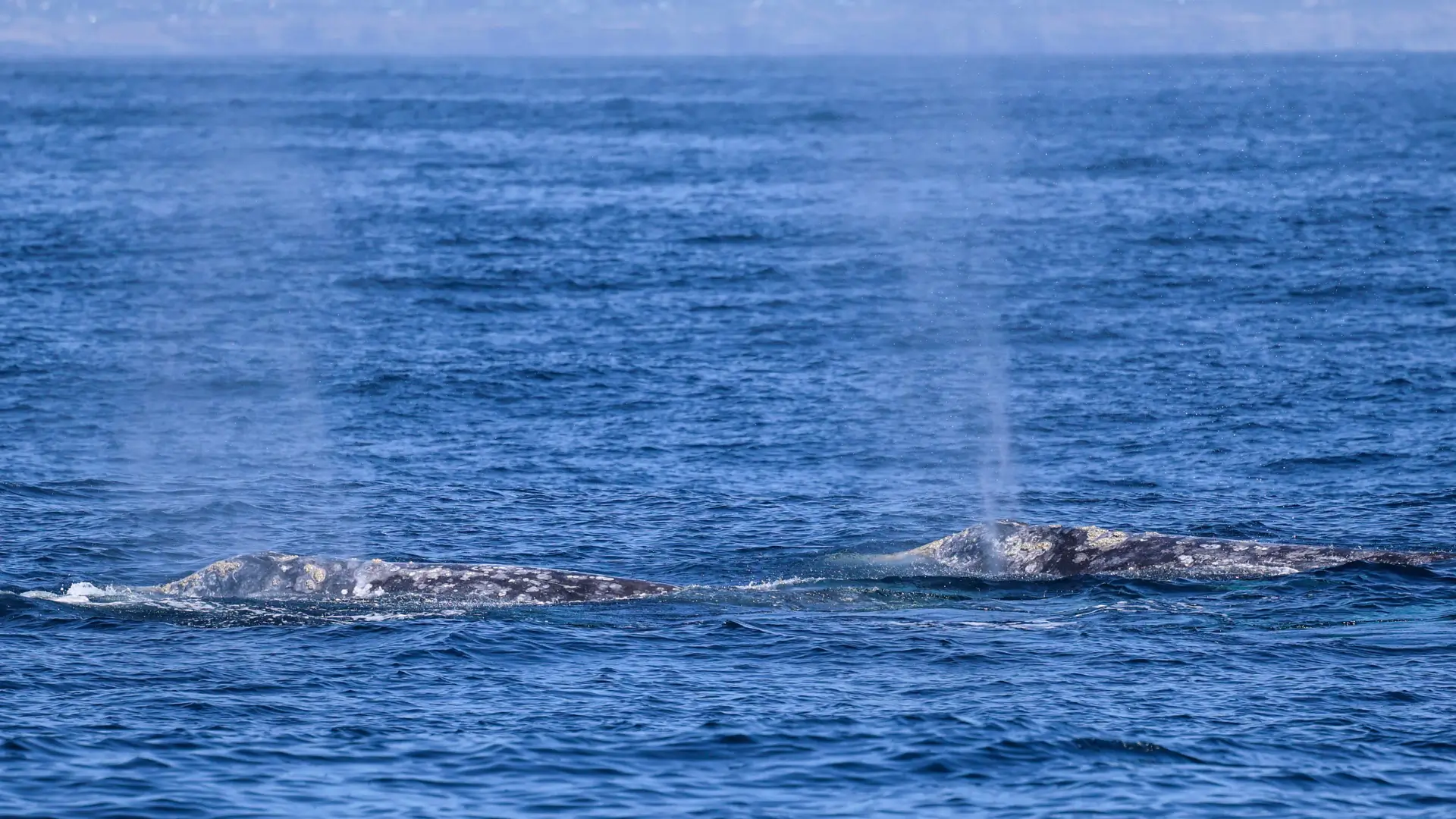
One of the most unforgettable experiences during gray whale season is encountering a mother traveling alongside her newborn calf.
Gray whales typically give birth in the protected lagoons of Baja California, but some mothers deliver their calves during the journey south.
Our naturalists have occasionally encountered very young calves traveling through San Diego waters, sometimes just days or weeks old.
With unusually warm ocean temperatures this year, could we see more calves born farther north?
It’s a fascinating question, but there’s currently no scientific evidence that this El Niño will cause gray whales to shift their primary birthing areas northward.
What we do know is that calf sightings provide valuable insight into the health of the gray whale population.
Scientists monitor calf production, body condition, and migration patterns to better understand how these animals are responding to environmental changes.
We’ll be especially interested in observing mothers and calves during the northbound migration, when they travel together toward their northern feeding grounds.
A Gray Whale Season Full of Questions and Possibilities
One of the things we love most about whale watching is that the ocean always has something new to teach us.
Our naturalists spend hundreds of hours on the water observing marine wildlife, documenting sightings, and noticing changes that might otherwise go unseen.
This winter, we’ll be watching for some particularly interesting developments.
Will gray whales arrive earlier than usual? Will January bring another extraordinary concentration of sightings? Will whales travel farther offshore on their return journey? And could changing ocean conditions lead to unexpected feeding behaviors?
We don’t have all the answers yet.
But we do have years of firsthand observations, historical sightings data, and a growing body of scientific research to help us understand what we’re seeing.
Throughout the 2026–2027 gray whale season, we’ll continue documenting our sightings and sharing what we discover.
And when the season ends, we’ll revisit these predictions to see how they compare with what actually happened.
Want to experience gray whale season for yourself?
Join San Diego Whale Watch for an unforgettable ocean adventure. Our expert naturalists will help you discover the fascinating wildlife that calls the Pacific home while sharing the science and stories behind what you’re seeing.
👉 Book Your Whale Watching Adventure
Wildlife sightings are never guaranteed to follow a particular seasonal pattern. Predictions reflect our naturalists’ observations and current scientific understanding, not confirmed forecasts of whale behavior.
Scientific Sources
- NOAA Climate Prediction Center — October 2026 El Niño Advisory
- National Snow and Ice Data Center — October 2026 Arctic Sea Ice Report
- NOAA Fisheries — Gray Whales in the Eastern North Pacific
- NOAA Fisheries — Closure of the 2019–2023 Gray Whale Unusual Mortality Event
Historical sightings data: San Diego Whale Watch internal sightings records, November 2022–May 2026. Naturalist observations: Alison Moors and Vanessa James, October 29, 2026.
